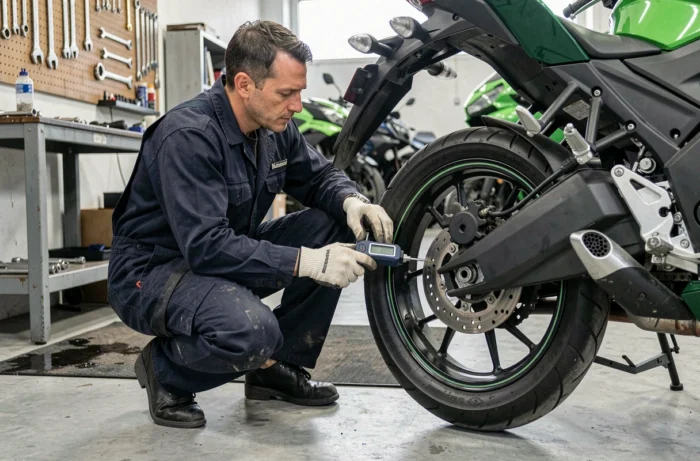
The Kawasaki ER6N has precise manufacturer-recommended tire pressures: 2.2 bar at the front and 2.5 bar at the rear when riding solo, with cold tires. These figures increase to 2.3 bar at the front and 2.8 bar at the rear with a passenger.
The difference between these two setups reaches 0.3 bar at the rear, enough to noticeably affect the bike’s handling. Checking tire pressure on the ER6N is about more than just reading a number: the method, timing, and interpretation of the result matter just as much as the pressure itself.
ER6N tire pressures for solo and two-up riding: figures by setup
| Setup | Front tire (120/70 ZR17) | Rear tire (160/60 ZR17) |
|---|---|---|
| Solo | 2.2 bar | 2.5 bar |
| With passenger | 2.3 bar | 2.8 bar |
| Motorway (journey > 2h) | +0.3 bar | +0.3 bar |
| Winter conditions | +0.2 bar | +0.2 bar |
The rear tire absorbs most of the change in load. Increasing pressure from 2.5 to 2.8 bar is a rise of more than 10%. Failing to adjust it for two-up riding means running the rear tire structurally underinflated for the actual load.
For extended motorway journeys, adding 0.3 bar to each tire compensates for continuous heat buildup and sustained high speeds. In winter, the 0.2-bar adjustment accounts for the contraction of the air volume inside the tire as the outside temperature drops. These adjustments are not cumulative: apply one or the other depending on the conditions, not both at the same time.
A detailed guide to ER6N tire pressure covers these figures along with considerations specific to the model’s different generations.
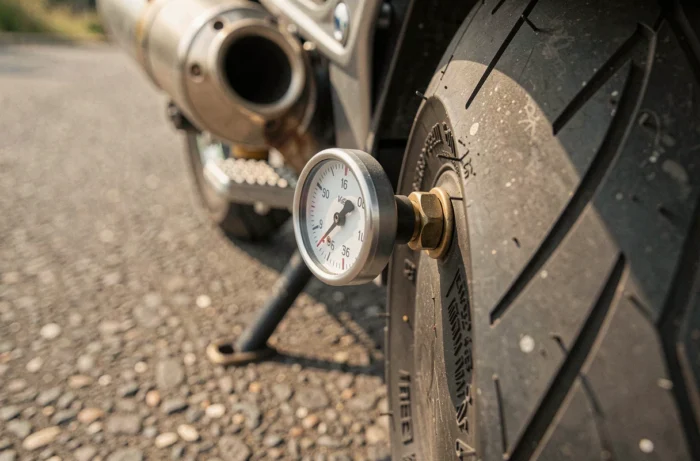
Measuring ER6N tire pressure when cold: what “cold tire” really means
All manufacturer-recommended pressures are specified for cold tires. Definitions vary by source, but Michelin considers a tire cold after it has been stationary for at least two hours, or after traveling less than 3 km at low speed. With the ER6N, the first mistake is inflating the tires at a gas station after riding several kilometers to get there.
Pressure naturally rises as heat builds up while riding. Deflating a hot tire to bring it back to the “cold” pressure is a mistake. Once the air cools, the pressure will drop below the required level. The right approach is to note the pressure measured while hot, ride home, then check it again when cold the next morning before setting off.
Outside temperature and false alarms
A tire inflated in a heated garage may show a lower pressure once the bike is parked outside in cold weather. This does not mean there is a leak. Tire pressure depends directly on the temperature of the air trapped inside the tire.
A common mistake is to top up by guesswork to compensate for this apparent drop, without checking again when the tire is cold and conditions are stable. On the ER6N, consistently using the manufacturer’s recommended pressure once the temperature has stabilized is the only reliable approach.
Underinflation and overinflation on the ER6N: effects on handling
These two mistakes have opposite effects, but neither is harmless.
- An underinflated tire increases the contact patch, causing the rubber to overheat. On the ER6N, this results in heavy steering, accelerated wear on the shoulders, and a risk of the tire coming off the rim in hard cornering.
- An overinflated tire reduces the contact patch to a narrow central strip. Grip decreases, the tire bounces more over bumps, and wear becomes concentrated in the center of the tread.
- A pressure difference between the two tires creates an imbalance in handling. The bike pulls to one side under braking or resists turning naturally, a particularly deceptive issue because it develops gradually.
The margin for error is narrow. On a 160/60 ZR17 rear tire, the difference between 2.5 bar (the solo-riding pressure) and 2.2 bar (moderate underinflation) is enough to change the tire’s contact profile and reduce stability in corners.
Recurring pressure loss on the ER6N: diagnose the cause before inflating
Regularly topping up without investigating the cause of pressure loss is a common mistake. A drop that returns between checks may indicate a structural problem: a faulty valve, a cracked rim, or a foreign object lodged in the rubber without causing an obvious puncture.
After a puncture or riding on a visibly deflated tire, restoring the seal by inflating it does not guarantee that the tire’s casing is intact. The stress placed on the internal plies at low pressure can create weak spots that are invisible from the outside. A professional assessment is still necessary before getting back on the road.
Plug repairs: limitations to be aware of
A tire plug can be a temporary fix, but it is not always reliable over the long term. The repaired area should be inspected regularly, and some types of damage (sidewall damage, a large puncture, or casing deformation) make the tire unrepairable. Mistaking a temporary seal for a permanent repair can lead to tire failure while riding.
How often to check ER6N tire pressure and the reliable method
Checking every two weeks is a reasonable minimum for regular use. Check the tires before every long journey. The most reliable method is to use your own pressure gauge at home, in the morning, before riding.
- Check both tires every time, not just the one that looks low.
- Always use the same pressure gauge to avoid calibration differences between devices.
- Record the date and readings to spot a downward trend over several weeks.
- Visually inspect the sidewalls and tread each time you check the pressure.
Gas station pressure gauges are often poorly maintained and can be off by several tenths of a bar. On a motorcycle where the tolerance is only 0.2 or 0.3 bar, this inaccuracy is enough to throw off the setting. A calibrated personal pressure gauge remains the go-to tool for consistently monitoring ER6N tire pressure.