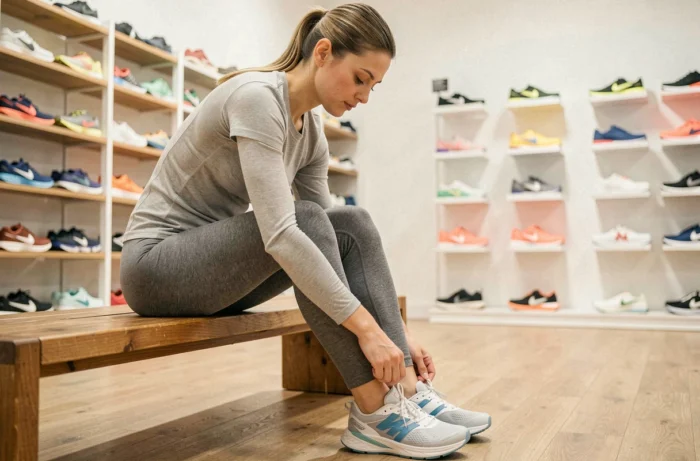
The size printed inside your running shoes only tells you their length. With Hoka, comfort depends just as much on the upper’s width, the toe box volume and the model-specific construction as it does on this simple measurement in centimetres. Confusing a length issue with a width issue is the most common mistake when choosing your Hoka size.
Length or width diagnosis: the test before choosing your Hoka size
Lateral compression and toes hitting the front of the shoe can cause the same discomfort, but they call for opposite fixes. Going up half a size to relieve pressure around the metatarsals makes the shoe longer without making it wider, pushes the foot forward and compromises the fit.
Check the exact model you’re considering in two steps:
- Push your foot forward until your toes touch the front of the shoe. Slide a finger behind your heel: if your index finger fits without forcing it, the length is right. Otherwise, the shoe is too short.
- Move your foot back into its normal position and check the metatarsal area. If the upper presses against the outer edge of the fifth metatarsal, the issue is width, not length.
- Check the toe box: your toes should be able to spread slightly without rubbing against the upper mesh. Rubbing on top of the big toe indicates insufficient volume, not a lack of length.
If the diagnosis points to lateral compression, the Wide version of the same model in the same size will solve the problem better than going up half a size in the standard width.
Reviews posted on the official Mafate 2 OG product page illustrate this pitfall. Some users describe the shoe as too large, while others find it tight, because they confuse excess length with insufficient width. These conflicting reviews relate to one specific model and cannot be generalized to the entire Hoka range.
Hoka fit by model: Clifton, Bondi, Mach
There is no single sizing rule that applies across the entire range. Differences in fit between Hoka models can sometimes be greater than those between two competing brands.
The Clifton 10 has a snug fit and a breathable jacquard upper that hugs the midfoot more closely than previous versions. A runner who found the Clifton 9 comfortable with a little room to spare may find the Clifton 10 tighter in the same size. For reviews of Hoka women’s sizing, comparing different generations of the same model provides more reliable guidance than a generic conversion chart.
The Bondi 9 is the opposite: its more accommodating upper offers extra volume in the toe box. Switching from the Clifton to the Bondi in the same size may leave a little extra room around the heel.
A special case: unisex models
Some Hoka models are available in a unisex version with dual sizing (men’s and women’s sizes separated by a slash). The men’s size is always the smaller of the two. Reading the wrong column will shift your size by a full size.
Measuring your foot in centimetres: the only reliable reference across brands
US, UK and EU sizing systems do not align perfectly from one brand to another. Measuring in centimetres is the only common reference for switching from another brand to Hoka without an unpleasant surprise.
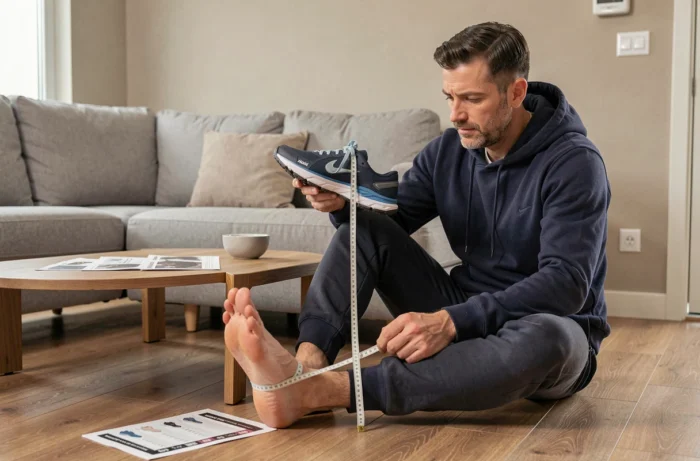
Place your bare foot on a sheet of paper positioned against a wall, mark the tip of your longest toe and measure the distance. Add about five millimetres to allow for foot movement while running. You’ll find this measurement on the inside label of every Hoka model under “CM” or “JAPAN”.
Since mid-2025, some women’s models (Clifton 10, Arahi 8, Challenger 8) have shown a centimetre measurement that is 0.5 cm different from previous versions, with no change to the actual shoe size.
A women’s US 7.5 used to show 24.5 cm on the label; it now shows 24 cm. The change is in the labelling, not the shoe. If you’re comparing an older pair with a new one, rely on the US or EU size, not the centimetres printed on the tongue.
Hoka sizing and foot shape: wide feet, flat feet and bunions
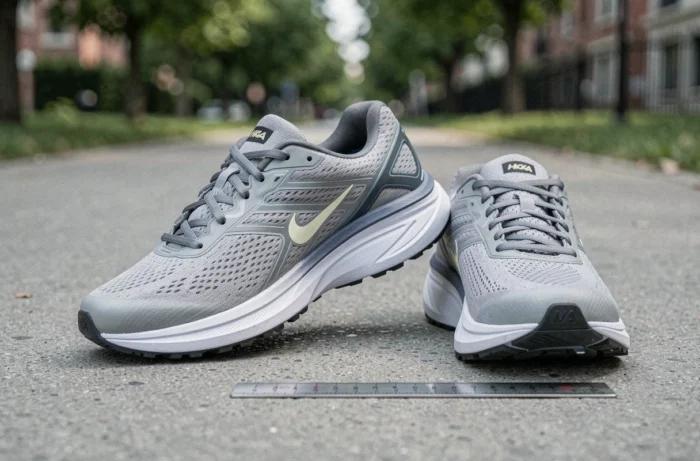
Wide feet and flat feet need different solutions. The former need extra room across the foot (the Wide version). The latter need medial support, which width alone cannot provide.
- Wide feet without excessive pronation: choose the Wide version of your preferred model in your measured size, without sizing up.
- Flat feet with overpronation: the Arahi offers enhanced medial support. Its Wide version combines support and extra room, so you don’t have to sacrifice stability to gain space.
- Hallux valgus: the pressure point is along the inner edge of the toe box. Models with a soft jacquard upper (Clifton 10) put less localized pressure on the foot than reinforced mesh, but this model’s snug fit may cancel out that benefit. Trying both widths in this specific model is the only reliable way to decide.
Sizing up to accommodate a bunion shifts the heel and causes slippage that can lead to blisters. Width matters more than length.
Hoka fit comes down to three factors (length, width and toe box volume), which vary from one model and generation to another. Measuring your foot in centimetres gives you a starting point, but only trying on the exact model in the right width ensures a reliable size choice.