
The French property market has been in a correction phase since the second quarter of 2026. In its report dated 22 October 2026, the Conseil supérieur du notariat notes that the recovery in sales is slowing and that prices for existing homes are falling again, with houses declining more sharply than apartments. For property buyers and investors, this shift is changing the balance of power between buyers and sellers and making market signals harder to interpret.
At the same time, the rules are changing. Since 1 September 2026, MaPrimeRénov’ has been tightened for certain standalone renovation works. This regulatory adjustment directly affects the calculation of a purchase budget or the profitability of a buy-to-let investment.
Property prices and negotiating power: what the notarial figures reveal
The national trend masks sharp differences between local markets. Notaries report that prices for existing homes began falling again in the second quarter of 2026, following a period of stabilisation. Houses have seen a steeper decline than apartments, creating different opportunities depending on the type of property you are looking for.
For buyers, this situation makes it more important to analyse prices at neighbourhood or town level rather than relying on national figures. Comparing the price per square metre of several similar properties in the same area remains the most reliable way to assess an asking price. Specialist platforms and notarial data provide access to these local benchmarks. Regularly following property news on Chronique Française can also help put price movements in different areas into context.
The return of negotiating power for buyers is a notable feature of this period. Negotiation is once again a practical way to bring down the final price, provided it is backed by figures rather than gut feeling.

Energy performance ratings and renovation: what to check before buying a property
The energy performance certificate (DPE) is playing an increasingly important role in purchasing decisions and property valuations. Notaries have noted an apparent improvement in the distribution of sales by energy rating. However, this may be due to changes in the calculation method, particularly for homes under 40 m² and those heated with electricity.
A favourable DPE rating does not mean the property has been renovated recently. Before relying on the displayed rating, check what work has actually been carried out, when the assessment was done and which method was used. A property rated D after a methodological recalculation is not equivalent to one rated D after loft insulation and boiler replacement.
This is a matter of direct financial importance. Properties rated E are now subject to increasing restrictions on rental. For investors, buying a property with a poor DPE rating without budgeting for the work needed to meet the standards means underestimating the true cost of the project.
MaPrimeRénov’ since September 2026: what support is still available
The tightening of MaPrimeRénov’ on 1 September 2026 removed some grants for standalone work under the “par geste” scheme. In practical terms, buyers who planned to use this support to fund a window or radiator replacement will need to revise their financing plan.
- Whole-home renovations (a package of works covering several energy-related areas) remain eligible for the most substantial grants.
- Certain standalone measures, such as replacing a heating system with a heat pump, may still qualify for support, subject to income and energy-efficiency conditions.
- The application must be prepared before signing the preliminary sale agreement so that administrative processing times can be factored into the project schedule.
Renovation grants can change the work plan before you even buy. Consulting a France Rénov’ adviser before making an offer on an energy-inefficient property can help you adjust your overall budget.
Property budget and mortgage: plan your project without overlooking costs
Financial planning for a property purchase involves more than the asking price. Notary fees account for around 7 to 8% of the price for existing properties and 2 to 3% for new-builds, according to the notaries of France. These costs, often underestimated by first-time buyers, are added to the purchase price and are not covered by the mortgage in most cases.
Three cost areas should be carefully calculated before you start actively searching:
- Purchase costs (notary fees, guarantee fees and bank arrangement fees), which vary depending on whether the property is new or existing.
- Any renovation costs, taking the revised MaPrimeRénov’ rules into account to estimate the actual amount you will need to pay.
- Ongoing costs (property tax, condominium fees and mortgage insurance), which determine whether the project remains affordable over time.
Interest rates remain a key factor when it comes to mortgages. Your borrowing capacity depends on the rate you secure, the loan term and the maximum debt-to-income ratio. Comparing several mortgage offers or using a broker can often save you a few tenths of a percentage point, adding up to several thousand euros over the full term of the loan.
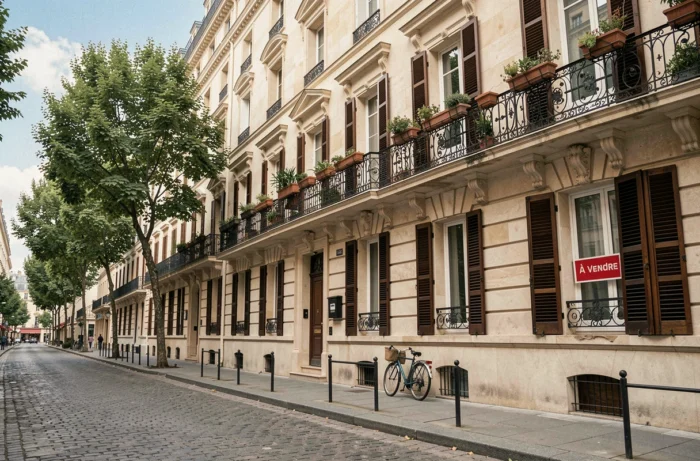
France’s property market: read the signals without jumping to conclusions
An increase in transaction volumes does not automatically mean prices are rising. The two indicators can move in opposite directions for several quarters, as notaries have observed in their latest market report.
For buyers and investors, the most useful data is not the national sales volume, but the average time a property takes to sell in the area they are targeting and the gap between the asking price and the final sale price. These local indicators reflect on-the-ground conditions better than a national trend line.
In 2026, success in the French property market depends on careful preparation: looking beyond the DPE rating, calculating all additional costs and basing negotiations on local data. The rules have changed, and projects built on outdated assumptions risk running into unexpected costs or delays.