The fashion market is caught between two opposing forces. On one hand, trend cycles are speeding up, driven by social media and fast fashion. On the other, the rise of secondhand shopping and the first European regulations on textile traceability are encouraging more considered purchases.
In this context, putting together a personal style is no longer just about aesthetic pleasure: it also means balancing what the market offers against what truly suits your figure, habits and values.
Fashion trends 2026: what’s in and what lasts
Seasonal trends come and go at a pace amplified by social media. A cut or color spotted on a runway can flood news feeds within days, then disappear just as quickly.
For anyone looking to develop a lasting style, the challenge is to distinguish enduring trends from passing fads. Oversized cuts, for example, have remained popular for several seasons, while some bold prints don’t last beyond a single summer. Keeping an eye on trends is useful, but the rule of thumb is simple: a trendy piece that doesn’t work with anything already in your wardrobe will end up forgotten on a hanger.
To keep up with changing styles without accumulating more clothes, MaxiScoop’s fashion section regularly features analysis of pieces that stand the test of time, beyond the novelty factor.
Colors and fabrics: two practical ways to shape your personal style
Color is often the first thing people notice about an outfit, even before its cut. Choosing shades that work with your skin tone, hair and eye color gives your style an immediate sense of cohesion, without the need for complicated coordination.
Find your color palette
Rather than following the color of the year, start with what’s already in your wardrobe. Looking at the clothes you wear most often can reveal your natural palette. If navy, off-white and burgundy keep showing up, that’s a reliable clue.
Building outfits around three to five recurring colors makes it easier to put looks together and helps curb impulse buys. A trendy piece in a color you already wear will fit right in.
Fabrics: the often-overlooked factor
Fabric affects how a garment drapes, how comfortable it feels and how long it lasts. The same shirt will look very different on your figure in polyester than it will in heavyweight cotton.
- Cotton and linen offer breathable comfort in warmer weather, with a natural drape that suits most body types.
- Merino wool and cashmere add structure in winter without adding bulk, provided you choose a sufficiently dense fabric.
- Synthetic fabrics (polyester, elastane) offer stretch and durability, but tend to look less refined in dressier pieces.
Choosing natural fabrics for clothes worn next to the skin and saving synthetic blends for technical or sportswear is a sensible compromise.
Secondhand and circular fashion: an underrated way to develop your style
Secondhand shopping is no longer limited to online platforms. Brick-and-mortar thrift stores and consignment shops are also opening in city centers, making it possible to try things on and check their condition before buying. For creating a distinctive style, these outlets offer an advantage that mass-market retailers can’t guarantee: one-of-a-kind pieces or designer labels at a fraction of their original price.
Brands themselves are starting to offer their own secondhand collections, but these still make up only a small share of the resale market. Most secondhand stock continues to circulate through individuals and independent resellers.
Meanwhile, the European ESPR Regulation (2024/1781), which came into force in July 2024, provides for a digital product passport for textiles. However, the delegated act for textiles has not yet been adopted, and the precise requirements (the information to be displayed and the implementation timeline) have not been finalized. In time, this system could make resale easier by providing reliable information about the composition and origin of garments.
Building a cohesive wardrobe: a process of elimination
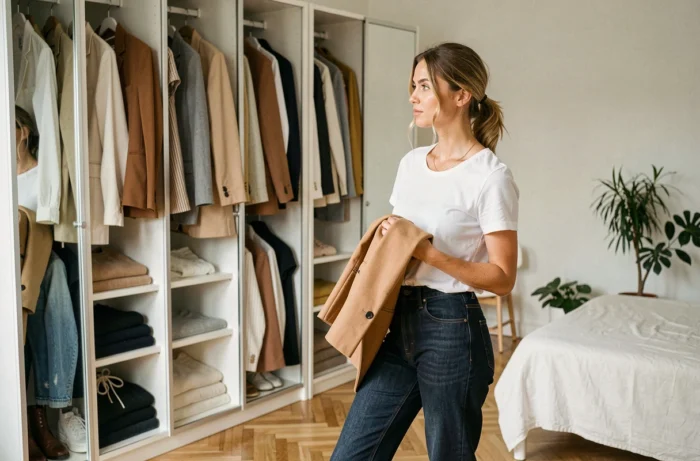
Most style advice starts with what you should buy. The opposite approach works better: getting rid of pieces you haven’t worn in over a year clears the visual clutter from your wardrobe and reveals what’s actually missing.
Once you’ve sorted through everything, your needs become clearer. Perhaps you’re missing a pair of dress pants in a fluid fabric, or a mid-season jacket in a neutral color. This practical assessment replaces the habit of accumulating impulse buys.
Accessories: change things up without replacing everything
Accessories (belts, scarves, jewelry, bags) can change the look of an outfit without altering its main pieces. The same outfit can take on a completely different feel depending on whether you pair it with white sneakers or leather ankle boots.
Investing in two or three well-made accessories rather than a dozen cheap pieces can extend the life of your style without overcrowding your wardrobe.
Body shape and personal style: what style guides oversimplify
Letter-based classifications (A, V, H, O, X) are everywhere, but they reduce the diversity of body shapes to just five patterns. In practice, most figures fall somewhere between two categories, and proportions vary depending on height, posture and muscle distribution.
Trying clothes on is still the only reliable test. High-waisted pants can make a shorter figure look longer on one person and more compact on another. Size and shape charts offer a starting point, not an absolute rule.
Two guidelines work better than a body-shape chart: knowing where your natural waist sits (above or at your navel) and understanding how broad your shoulders are compared with your hips. These two details are enough to guide your choice of jacket, dress and trouser cuts without forcing every purchase into a category.
Personal style rarely comes together in a single shopping trip. It takes shape through a series of consistent choices over several seasons: keeping what works and letting go of what never makes it back onto your shoulders.