
A bank overgrown with brambles behind the house, tough regrowth along a fence, a strip of land too steep for a lawn mower: these are often the situations that make you realize a simple grass trimmer is no longer enough. Choosing a powerful brush cutter to maintain your garden means starting with what you actually need to cut, rather than an abstract spec sheet.
Petrol or battery-powered brush cutter: let the terrain decide
For a relatively flat, modest-sized garden with tall grass but little woody vegetation, a battery-powered model gets the job done without the noise or hassle of a petrol engine. It starts at the push of a button, can be stored without draining the fuel, and remains lightweight.
The limitations become apparent as the area grows or the vegetation gets tougher. A standard battery runs down faster when tackling thick brambles or scrub. You may need a second battery, which adds to the cost. On a large or sloping plot where the work takes more than an hour, a petrol engine lasts longer and delivers consistent power regardless of its fuel level.
You can find models suited to every situation at debroussailleuse-warrior.com, filtering by power source and intended use.
One often-overlooked point is the availability of replacement batteries. From February 18, 2027, the European Batteries Regulation will impose requirements for the removal and replacement of certain portable batteries, as well as the availability of spare parts. Before buying, check whether the manufacturer offers a compatible battery at a reasonable price to avoid ending up with an unusable machine after a few seasons.
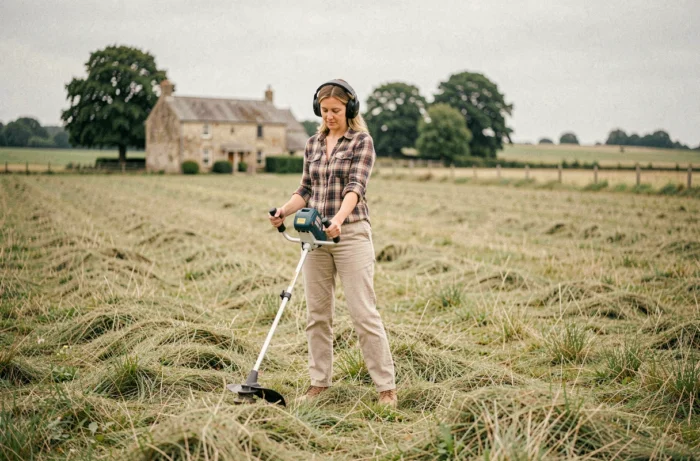
Cutting head and blade: match the tool to the vegetation
The choice of cutting system has a major impact on the machine’s effectiveness. There are three main configurations, each suited to a specific type of vegetation:
- Nylon line (round or square) is suitable for soft grass, edging and regular trimming of uncut lawns. It wears quickly on tough stems, but it is inexpensive and easy to replace.
- A three- or four-tooth blade tackles brambles, young woody shoots and dense scrub. It requires an engine powerful enough to maintain its rotational speed under load.
- A brush blade, similar to a circular saw blade, is used to cut green wood and shrub regrowth. It requires a safety harness and, for petrol models, a machine with a suitably large engine displacement.
Choosing the cutting head before the machine makes it easier to select the right power level. Buying a powerful brush cutter only to use nylon line means paying extra for unnecessary weight and fuel consumption. Conversely, fitting a toothed blade to an underpowered engine can cause it to stall and wear out prematurely.
Real versatility or marketing hype
Most models accept several interchangeable cutting heads. In practice, you rarely use more than two configurations in the same garden. It’s better to identify the two main tasks (for example, edging with line and annual brush clearing with a blade) and check that the machine comes with the right accessories, rather than paying for a complete kit when half of it will stay in the garage.
Weight, harness and comfort: what matters after thirty minutes
In the shop, you lift a brush cutter for a few seconds. Out in the garden, you carry it for an hour or more, with your arms extended, often on a slope. Comfort depends on three practical factors that product specifications don’t always make clear.
The total operating weight (with a full tank or battery installed) gives you the true load. A mid-displacement petrol model weighs considerably more than a battery-powered one, but weight distribution matters just as much as the number itself. A straight drive shaft shifts the weight forward, while a curved shaft brings it closer to your body.
A harness makes all the difference during long sessions. A simple shoulder strap is enough for short jobs. For intensive brush clearing on slopes or in woodland, a double-shoulder harness with a suspension hook frees up your arms and distributes the load across your shoulders and hips. Without one, lower back pain can set in quickly.
Vibrations transmitted to your hands and forearms cause more fatigue than you might expect. Models with an anti-vibration system (rubber mounts between the engine and shaft) reduce this effect. For occasional use, the difference is minimal. For regular sessions, it helps protect your joints.
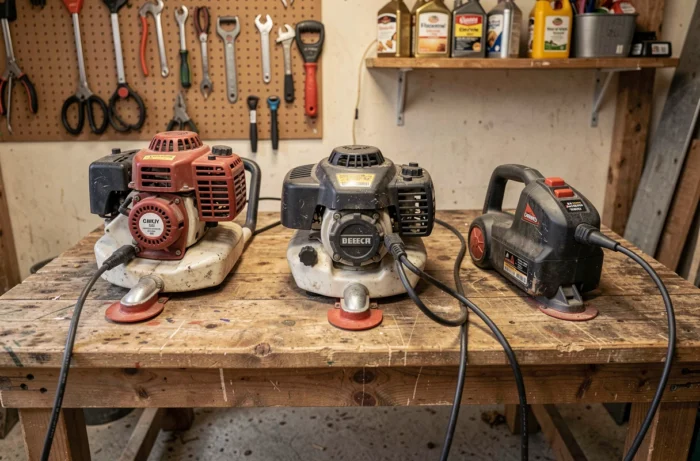
Brush cutter running costs: more than just the purchase price
The shelf price is only part of the overall cost. With a petrol model, fuel and oil, air filter and spark plug replacements, and blade sharpening or replacement all add up over time. With a battery-powered model, electricity costs are negligible, but replacing the battery after a few hundred charge cycles can cost a third of the machine’s original price.
Nylon line wears out quickly over large areas or when used around obstacles such as walls and rocks. A spool typically lasts a few sessions on an average-sized plot. Metal blades, on the other hand, can be sharpened several times before they need replacing.
Maintenance and repairability
Before buying, check whether the retailer network offers spare parts (starter assembly, clutch, bevel gear). This gives you an indication of how long the machine can remain in service. A model from a well-known brand with a network of authorized repairers may cost more upfront, but it will stay operational much longer than a model with no technical support.
Choosing a brush cutter comes down to matching the terrain, the vegetation and how often you’ll use it. Starting with these three practical factors, rather than a price range or brand preference, will help you choose a machine you’ll actually use instead of leaving it at the back of the garage after two seasons.