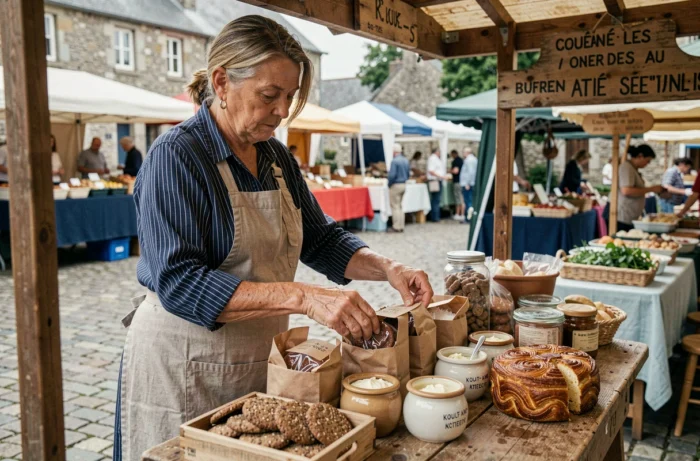
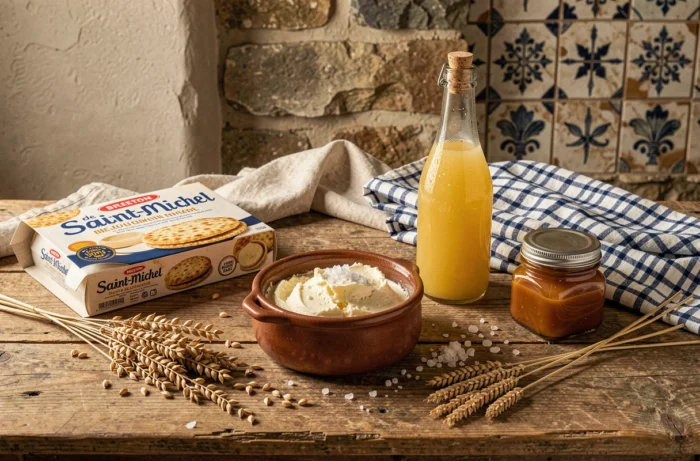
A packet of biscuits stamped “Breton recipe,” salted butter caramel in an artisan-style jar, cider decorated with a triskel: the word “Brittany” on a package guarantees neither where it was made nor where its ingredients came from. Choosing authentic Breton products means reading labels carefully, distinguishing official quality marks from marketing claims, and choosing products suited to the length of your journey home.
Breton product labels: what each claim means
Start by checking the manufacturing address, which must appear on the packaging. A regional specialty can certainly be made in Brittany using ingredients from elsewhere. The claim “made in Brittany” tells you where the product was processed, not where the butter, flour or fruit came from.
To find out more, check the ingredients list to see how much of the product’s characteristic ingredients it actually contains. In a buckwheat biscuit, for example, if buckwheat flour appears third, after sugar and wheat flour, the biscuit contains relatively little buckwheat. Ingredients are listed in descending order by weight.
Producers who source locally often choose to say so: “Breton churned butter,” “buckwheat grown in Brittany,” “Guérande salt.” The absence of such details does not mean a product is fraudulent, but it is a reason to be cautious. For information on supply chains that specify the origins of their ingredients, visit https://www.terre-de-breizh.com.
Labels and official quality marks: a comparison of what they guarantee
Several quality marks appear on Breton products, and the level of assurance they offer varies. The table below summarizes what each one covers.
| Mark or claim | What it guarantees | What it does not guarantee |
|---|---|---|
| AOP / AOC | Geographical origin and a production method that complies with a monitored set of specifications | That all secondary ingredients come from the same area |
| IGP | A link to a region for at least one stage (production, processing or preparation) | That the entire process takes place in that area |
| Label Rouge | Higher quality than standard products in the same category | A specific geographical origin |
| “Produit en Bretagne” | Manufacture or processing by a member company based in Brittany | That every ingredient comes from Brittany |
| “Breton recipe” claim | Nothing in regulatory terms: it is a marketing claim | Any guarantee of origin or quality |
An official logo on the packaging is no substitute for checking the specifications for the product in question. For example, a Brittany cider IGP regulates apple varieties and the production area, whereas “salted butter caramel from Brittany” without an official mark is not subject to any specific requirements.
Compare products in the same Breton category
Two ciders labeled “Breton” can have very different characteristics. Alcohol content, fermentation method and apple varieties vary from one producer to another. Reading the back label can tell you whether the cider is “pure juice” or made from concentrate, and whether the apples come from identified orchards.
The same applies to biscuits. The amount and origin of the butter set an artisan product apart from an industrial one sold under the same name. A Breton shortbread biscuit listing “AOP churned butter” as its first ingredient after flour will taste different from one made with vegetable fat.
What to compare before you buy
- Where butter or buckwheat appears in the ingredients list: the higher up it is, the greater the proportion
- Whether official marks (AOP, IGP, Label Rouge) are present and appropriate for the product category
- Manufacturing address: a recognizable town in Brittany, not just a PO box or registered office
- Whether the origins of the ingredients (salt, butter, flour, fruit) are stated voluntarily
Transport and storage: choose according to your journey
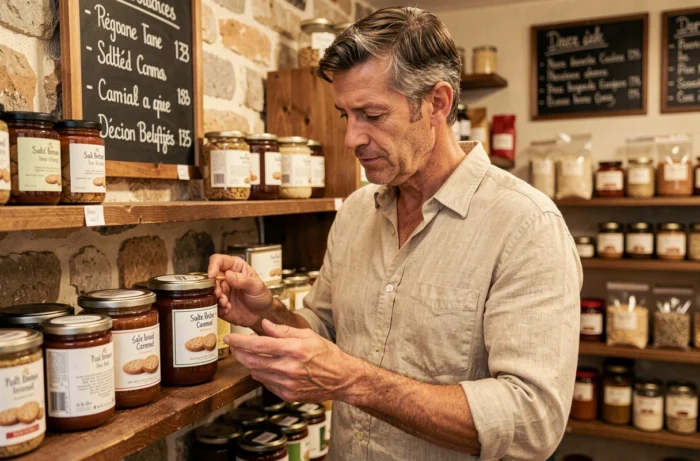
A Breton product bought at a market in Morbihan or a delicatessen in Finistère will travel differently depending on what it is. Canned goods, dry biscuits and confectionery can withstand several hours on the road without any special precautions. Salted butter caramel in a jar, biscuits in airtight packaging and sterilized pâtés all fall into this category.
Fresh products require more care. Churned butter, cheese and artisan pâté need to be kept cold, even for a short time. An insulated bag and an ice pack are enough for a journey of a few hours, but beyond that, the product’s quality will deteriorate.
Fragile products and shelf life
Farmhouse cider in a capped bottle travels well, as long as it is kept upright and away from heat. Fresh crêpes and galettes, on the other hand, rarely keep for more than a few days and do not travel well for long without refrigeration.
- Long shelf life (several weeks to several months): biscuits, jarred caramels, canned fish, salt, dried seaweed
- Medium shelf life (a few weeks when kept cool): corked cider, jams, sterilized pâtés
- Short shelf life (a few days, refrigerated): raw-milk butter, cheeses, fresh pâtés, artisan crêpes
Choosing a product that suits your journey time helps avoid disappointment when you arrive. A box of shortbread and a jar of caramel can travel across France without a problem. A seafood platter cannot.
Ultimately, choosing an authentic Breton product comes down to three simple steps: check the manufacturing address, read the ingredients list in order, and look for official quality marks rather than decorative claims. The rest is a matter of taste—and Brittany offers plenty of choice, so every carefully read label can lead to a genuine discovery.