
Finding a feather inside your home often raises questions among French-speaking Muslims. Forums, social media and some specialist websites offer a range of interpretations: an angelic message, a sign from a deceased loved one, an answer to a prayer. The question is better framed another way: are these interpretations based on identifiable religious texts, or do they stem from personal and cultural associations?
A feather in the home and Islamic texts: what the sources actually say
The most reliable starting point is to look in Islam’s two normative sources—the Quran and the hadith collections—for any mention linking the discovery of a feather to a divine or angelic message. Research into this specific question has found no instruction in the Quran or the hadiths assigning religious significance to finding a feather at home.
The Quran refers to birds, notably in Surah 16, verse 79, where they are presented as a sign of divine creation. This reflection concerns birds in flight and the mechanics of flight itself as evidence of creative power. Nothing in this verse or its classical commentaries turns a single feather, fallen in a living room or on a balcony, into a personal message addressed to someone.
The meaning of a white feather in Islam is discussed on many online pages that rightly distinguish religious texts from popular interpretations circulating in Muslim communities. This distinction is the guiding principle of any serious reflection on the subject.

Ṭiyara and omens: the Islamic framework that applies to feathers
Rather than seeking a meaning specific to feathers, Islamic tradition provides a general framework that applies to any object or event to which one might be tempted to assign predictive power. This framework is called ṭiyara.
The hadith narrated in Sahih al-Bukhari 5754 is explicit: “There is no ṭiyara.” Ṭiyara refers to taking an omen—good or bad—from an event, animal, object or direction. In pre-Islamic Arabia, people would observe the flight of birds before making a decision. Islam broke with this practice by affirming that everyday events have no predictive power.
Applied to a feather, this framework means that believing its discovery can predict a future event, confirm a choice or signal danger amounts to belief in omens. Whether the feather is white, black or gray makes no difference to this textual analysis: no hadith distinguishes feathers by color to assign them different messages.
Fa’l and optimism: an important distinction
The same hadith (Sahih al-Bukhari 5754) mentions fa’l, which the Prophet appreciated. Fa’l refers to the spontaneous optimism prompted by an auspicious word or a positively perceived event. The difference from ṭiyara is precise: fa’l is an inner disposition, a surge of hope, whereas ṭiyara means attributing causal power over the future to an object or event.
Finding a feather and feeling a sense of calm falls within the emotional realm. Believing that the feather confirms a deceased loved one is watching over you, or validates a career decision, crosses into the realm of omens.
Istikhāra and feathers: a common misunderstanding about the answers to expect
A widespread belief links finding a feather to an answer to the istikhāra prayer (the prayer for guidance). After performing this prayer to seek divine guidance when faced with a choice, some people interpret the feather as confirmation.
The texts on istikhāra do not present the discovery of an object as a prescribed answer. Istikhāra is not followed by an expected physical sign. Scholars generally describe the answer as the project being made easier or encountering an obstacle, sometimes accompanied by a feeling in the heart. Reading a feather as confirmation after this prayer confuses a personal interpretation with an established religious teaching.
This confusion is understandable: when faced with uncertainty, the desire for tangible confirmation is human. The challenge is to recognize this psychological dynamic without giving it a theological status it does not have.
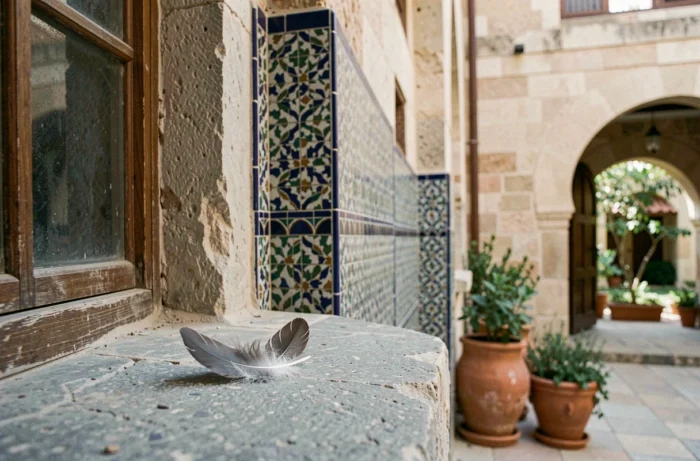
Personal comfort or religious authority: how to tell the difference
The most useful question is not “What does this feather mean?” but rather “What status am I giving to what I feel?” Here are some criteria to help you assess your own reaction:
- If the feather brings a sense of peace or gratitude without changing a decision you are considering, the reaction remains in the emotional realm and is compatible with fa’l as described in the hadiths.
- If the feather is interpreted as confirmation of a choice, an answer to a prayer or a message from someone who has died, the object is being given informational power, which falls under ṭiyara.
- If the feather causes anxiety (a bad omen or warning), the reaction falls into the classic category of superstition, explicitly rejected by the hadith “There is no ṭiyara.”
The line lies between what you feel and what you decide. Feeling a sense of gentleness when you see a feather is a subjective experience. Changing your behavior, postponing a trip or committing to something on the basis of that feather means granting it an authority that Islamic texts do not recognize.
Feather colors and their online “meanings”
Many websites assign different meanings according to color: a white feather is said to be a message of purity, a black one a warning, and a gray one a call for patience. These interpretive frameworks are not based on any identifiable Islamic source. They often borrow from non-Muslim spiritual traditions (shamanism, New Age spirituality) and are then presented in an Islamic context by association.
No hadith distinguishes feathers by color to assign them a message. Intellectual caution means identifying the true origin of a belief before considering it Islamic.
A feather in the home usually has a practical explanation: a duvet, pillow, bird that came in through an open window, or a draft. Recognizing this ordinary explanation takes nothing away from faith. The Quran invites us to contemplate creation as a whole, not to turn every household object into a personal oracle.