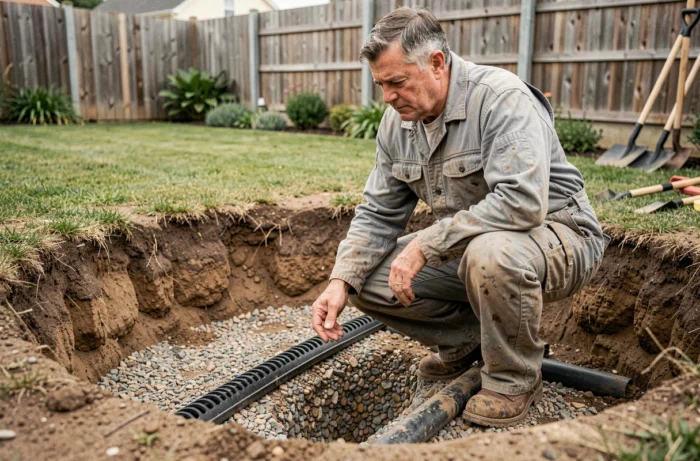
A soakaway is a buried structure that collects rainwater and returns it to the ground through gravity-fed infiltration. Unlike a connection to the sewer system, it operates without a pump or energy: water flows through a layer of gravel or pebbles and gradually reaches deeper soil layers. To understand its benefits, you first need to consider what happens below the surface, not just above it.
Soil permeability and soakaway feasibility
Before discussing the benefits, one technical factor determines everything else: the soil’s infiltration capacity. A soakaway works because a sufficiently permeable layer exists underground to absorb the collected water. Without this, the structure becomes little more than a tank that overflows.
Sandy or gravelly soils allow water to infiltrate quickly. Silty soils can also be suitable if the system is appropriately sized. Understanding the benefits of soakaways also means understanding these site constraints. Clay-dominant soil, however, presents two problems.
The first is mechanical: clay allows very little water to pass through. The second concerns building stability. The BRGM describes the link between drought, clay shrink-swell, and damage to buildings. During dry spells, clay shrinks, then swells again when moisture returns. Infiltrating water near a house on clay soil can worsen this movement and weaken the foundations.
Before installation, a soil survey (or at least a percolation test) can establish whether the project is feasible. This assessment also helps determine whether to choose a soakaway, a storage system with controlled discharge, or a vegetated solution.
Reducing runoff and protecting foundations
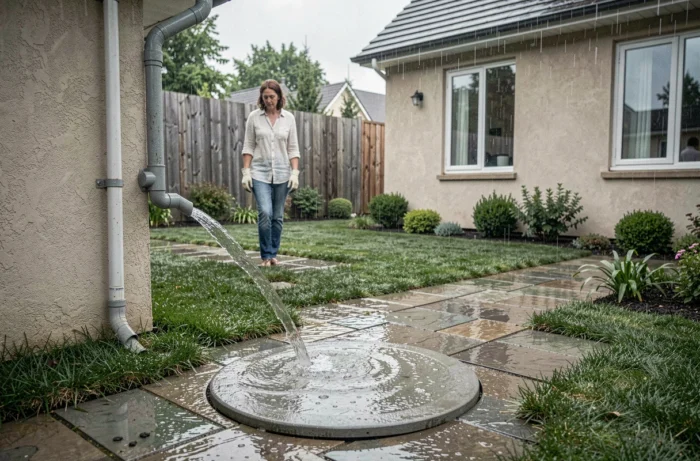
On a plot where the soil is suitable, a soakaway intercepts rainwater before it flows across the surface. Roofs, patios, and paved driveways generate runoff that the natural ground can no longer absorb. The structure captures this excess water and redirects it underground.
Less standing water around the house
Water that collects around a building can seep unpredictably along buried walls. It exerts hydrostatic pressure on the foundations and can cause rising damp. By diverting this water to a separate infiltration point, a soakaway protects the building’s structure.
The distance between the structure and the foundations matters. General recommendations call for leaving several metres between soakaways and buildings or property boundaries, but the exact distance depends on local regulations.
Groundwater recharge
Water that passes through a soakaway does not disappear. It reaches the underground aquifers and helps replenish the groundwater table. In areas where soil sealing is increasing, returning water to the natural environment partly offsets the effects of paved surfaces.
Local regulations and stormwater zoning
Stormwater management is not governed by a single national standard that applies in the same way everywhere. Requirements are often set at the municipal level through stormwater zoning and the PLU (local urban development plan) or PLUi (intermunicipal plan).
These documents can set very different requirements for each plot:
- Small rainfall events must be infiltrated directly on the plot, with no discharge to the public sewer system
- A maximum discharge rate is permitted if full infiltration is not possible
- A minimum retention volume must be provided on the plot before any potential connection to the sewer system
Check local planning documents before sizing a structure to avoid building a non-compliant soakaway. The town hall or municipal sanitation department can provide this information. In some cases, a prior works declaration is required.
Soakaway maintenance and signs of malfunction
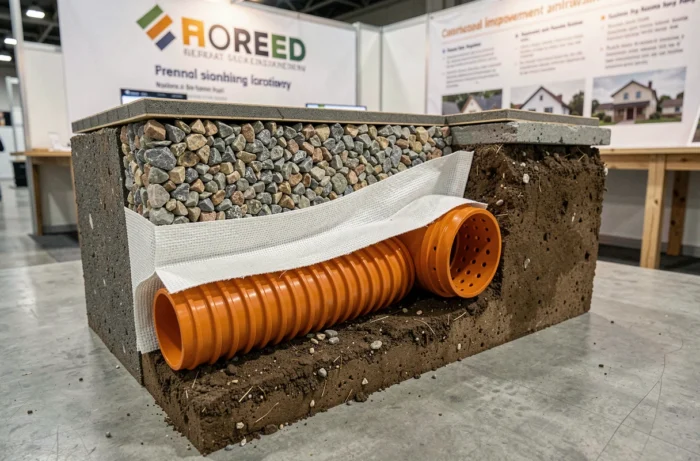
A properly sized soakaway requires little maintenance, but it will not work indefinitely without attention. Fine particles carried by rainwater (sand, decomposed leaves, roofing residue) gradually clog the drainage materials and the geotextile surrounding the structure.
Regular maintenance involves a few simple checks:
- Clean the inspection chambers and upstream filters to limit debris entering the soakaway
- Check that water drains normally after heavy rain, without remaining on the surface for an extended period
- Inspect the soakaway’s access chamber, if there is one, for an unusually high water level
- Clear sediment from the bottom of the soakaway every few years if deposits build up
If water takes several days to disappear after rainfall, or puddles reappear around the structure, the soakaway is probably starting to clog. Acting early (clearing it out or partially replacing the gravel) costs far less than a complete overhaul.
Soakaway or vegetated solution: when to consider an alternative
A soakaway is not the only way to manage rainwater on a plot. Rain gardens and vegetated swales hold water at the surface, filter it through their roots, and allow it to infiltrate slowly. These systems combine water management with attractive landscaping.
On land where the soil is not permeable enough for a soakaway, or where the water table is too close to the surface, a vegetated storage system with controlled discharge may be preferable. Water is held temporarily, then released at a low rate to an approved outlet.
The choice depends on three factors: soil type, available space, and the requirements of the municipal stormwater zoning plan. A soakaway is suitable for plots with permeable soil and limited surface space. A swale or rain garden requires more space but can accommodate less permeable ground.
Whichever system you choose, the principle is the same: manage rainwater where it falls, on the plot, rather than transferring it to an already overburdened public sewer system.