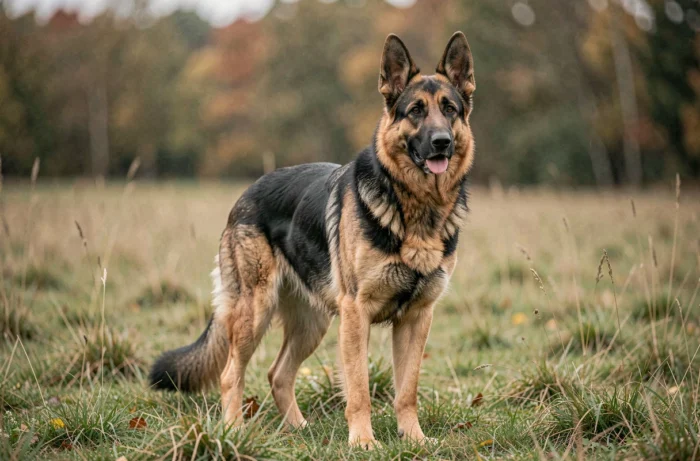
The German Shepherd–Beauceron cross is not a breed recognized by the LOF or by any official breed standard. It is a hybrid dog whose temperament depends as much on its parents’ genetics as on its individual experiences. General descriptions of this cross are widely shared online, but they obscure a more nuanced reality: every puppy inherits an unpredictable combination of traits, and claims that mixing two breeds creates a “balanced blend” are not backed by any concrete guarantees.
Predicting the temperament of a German Shepherd–Beauceron cross: what genetics can really tell us
Both parent breeds have several traits in common: high intelligence, plenty of energy, and a strong protective instinct. Many online guides conclude that a crossbreed will inherit “the best of both worlds.” This is an oversimplification.
A first-generation cross does not produce a uniform result. A puppy may take more after the Beauceron (strong independence, pronounced territoriality) or the German Shepherd (intense attachment to its primary person, emotional reactivity). Some will combine the Beauceron’s independence with the German Shepherd’s sensitivity, resulting in a dog that is both difficult to manage and emotionally vulnerable when left alone.
Adopting a German Shepherd–Beauceron cross means observing the puppy or adult dog’s actual behavior rather than relying on a theoretical breed profile. According to the Centrale Canine guide, even the data available in LOF Select has limitations for purebred dogs; for a crossbreed, there is no standardized framework for interpretation.
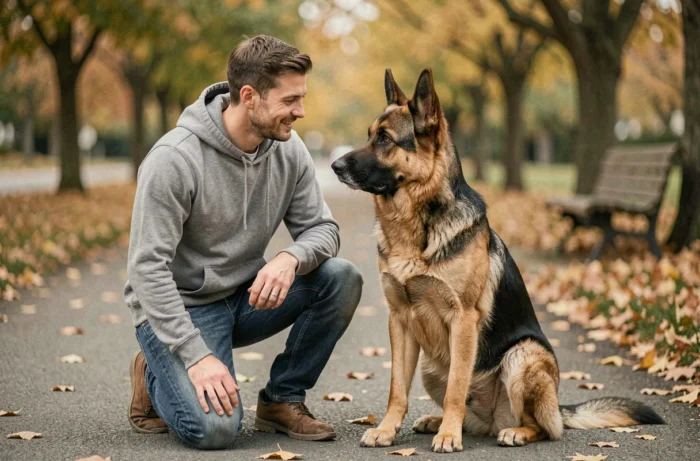
Training a Beauceron–German Shepherd cross: why the approach matters more than firmness
The most common recommendation for this type of dog is to use “firm but kind training.” In practice, however, trainers can interpret this phrase in very different ways.
Distinguishing restraint from structure
A dog descended from two working breeds needs clear boundaries. Regular mealtimes, consistent household rules, and predictable daily exercise. A structured daily routine takes the place of physical restraint for this type of dog.
Aversive tools (choke collars, shock collars) can cause documented behavioral side effects: increased reactivity, negative associations with certain situations, and a deterioration in the relationship with the owner. These risks are heightened in a dog that already has a strong protective instinct.
Early and ongoing socialization
Both Beaucerons and German Shepherds can become wary of strangers if they are not adequately socialized. In a crossbreed, this trait may appear very early or emerge later, during adolescence (at around eight to eighteen months).
- Introduce the puppy to a variety of environments (urban, rural, noisy) from the first few weeks after adoption, while respecting its pace
- Arrange regular meetings with dogs of different sizes, favoring calm interactions over overcrowded dog parks
- Get the dog used to interacting with people outside the household, including children, without forcing contact if the dog shows signs of stress
Socialization does not end when the puppy stage is over. A German Shepherd–Beauceron cross that is no longer exposed to a variety of stimuli after six months of age may regress, especially if it lives in an isolated environment.
Joint health in crossbreeds: monitor the hips and elbows without becoming alarmed
Both parent breeds are among those predisposed to hip and elbow dysplasia. Crossbreeding does not protect against this risk, but it does not guarantee it either. A crossbreed is not destined to develop dysplasia simply because its parents belong to breeds that are predisposed to it.
For a puppy with a traceable background, asking for the parents’ screening results (graded X-rays) is still the most useful step. If the dog is adopted from a shelter or taken in without any history, this information will be unavailable, so you will need to rely on routine veterinary care.
In an adult dog, several signs warrant a prompt veterinary appointment:
- Intermittent or persistent limping, especially after exercise
- Stiffness when getting up, particularly noticeable in the morning or after a long nap
- A gradual decline in stamina during regular walks
- Reluctance to climb stairs or jump into a vehicle
Limping in a dog of this size should never be attributed to fatigue without a veterinary examination. Untreated joint damage worsens over time and as the dog gains weight.
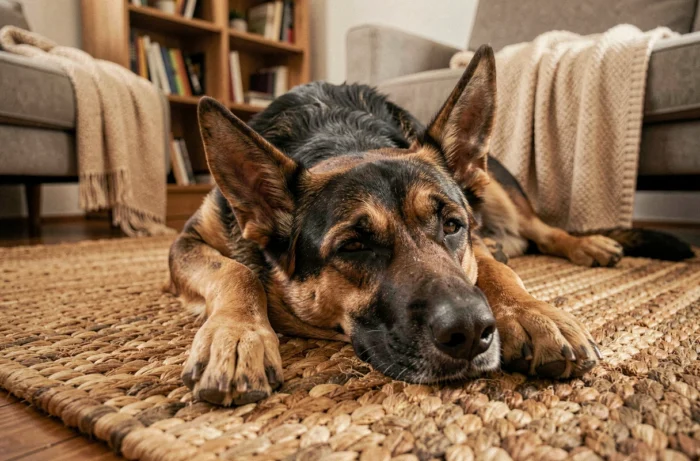
Everyday life with a German Shepherd–Beauceron cross: the real trade-offs
This crossbreed’s exercise needs are often described as “very high,” without being quantified in a useful way. In practice, the quality of stimulation matters more than the total length of the walk.
A dog from working lines that walks on a leash for two hours a day along the same route without any mental stimulation will be more frustrated than a dog that gets a 45-minute walk with tracking or obedience exercises built in. Using its nose, solving problems, and working with its owner tire this type of dog far more effectively than physical exercise alone.
Tolerance for being alone
Neither German Shepherds nor Beaucerons are known for coping well with long periods alone. Crossbreeds often inherit this sensitivity. Gradually teaching the dog to stay alone by increasing the duration in short increments reduces the risk of separation anxiety. It is best to start this training as soon as the dog arrives at home, not after destructive behavior has begun.
Living with other animals
Prey drive varies considerably from one dog to another. Some crossbreeds will live happily with a cat that was already in the home. Others may develop a fixation on small animals that training alone will not be enough to correct. Observing the individual dog’s behavior matters more than any generalization based on the cross.
The German Shepherd–Beauceron cross is still a dog that requires time, consistency, and careful attention to its signals. Breed profiles can never replace observing the dog right in front of you.